




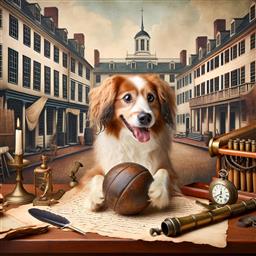
Welcome to a unique collection of canine appellations that harks back to a bygone era. This page is dedicated to providing you with a distinctive list of monikers that were popular in the 1720s. We have delved into historical records, literature, and art to bring you names that were once the choice for man's best friend during this rich period in history.
Take a stroll back in time, to an age where dog names reflected the language, culture, and societal values of the period. Often, these names were influenced by popular figures, nature, and even occupations. This compilation is perfect for those who appreciate history and want their canine companion to carry a name that's both unique and backed by centuries of tradition.
Whether you're looking for a name that represents strength, loyalty, beauty, or any other characteristic, these 18th-century dog names offer a treasure trove of options. This is a perfect opportunity for dog owners who wish to give their pets a name with a touch of historical charm and elegance. Let's delve into the world of yesteryears and discover names that have stood the test of time.
Names
| Name | Reason to Choose |
|---|---|
| Snuff | Reflecting the popular tobacco product of the 1720s, this name would work for a dog with a strong or distinct smell |
| Socrates | Named after the Greek philosopher, who was widely discussed in the 1720s |
| Sparta | Reflects the fascination with ancient civilizations during the Enlightenment |
| Spindle | Spinning wheels were common household items during the 1720s, making this a fitting name for a lively, energetic dog |
| Spode | Josiah Spode, a famous potter, was born in 1733 |
| Swift | A nod to Jonathan Swift, author of 'Gulliver's Travels' |
| Tabitha | A common female name during this period |
| Taffeta | Named after a luxurious fabric popular in the 1720s, this name would suit a dog with a shiny or glossy coat |
| Thaddeus | A popular biblical name during the 18th century |
| Titian | Named after the Venetian painter, reflecting the interest in Renaissance art during the 1720s |
| Tory | Another political party from the 1720s, a fitting name for a strong-willed or determined dog |
| Uriah | A frequently used biblical name in the 18th century |
| Ursula | A common female name during this era |
| Vellum | Inspired by the parchment used in the 1720s, a suitable name for a dog with a smooth or shiny coat |
| Vermeer | Named after the Dutch painter, whose works were rediscovered in the 1720s |
| Vesta | Named after the Roman goddess of the hearth |
| Violet | Reflects the popular flower names of the period |
| Virgil | Named after the ancient Roman poet, whose works were popular in the 1720s |
| Vivaldi | Antonio Vivaldi, a composer, was producing many of his famous works in the 1720s |
| Voltaire | Named for the French Enlightenment writer who was active during this time |
| Waistcoat | Reflecting the men's clothing of the 1720s, this would be a fitting name for a dog with a two-toned coat |
| Wedgwood | Josiah Wedgwood, a renowned potter, was born in 1730 |
| Whig | Named after the political party of the 1720s, this would be a suitable name for a dog with a bold or assertive personality |
| Wilfred | A popular male name during the 18th century |
| Wimple | Reflecting the headgear worn by women in the 1720s, this name would work for a dog with a gentle or demure demeanor |
| Winston | A popular English name during the 18th century |
| Xander | A name influenced by the Greek names popular in the period |
| Xenia | A name influenced by the Greek names popular in the period |
| Yale | A nod to the prestigious university founded before the 1720s |
| Yancy | A name that reflects the English influence of the era |
Groups
Inventions and Innovations Names
The 1720s was a time of many important inventions and innovations. Therefore, dog names inspired by these advancements could be unique and memorable.
| Name | Description |
|---|---|
| Ampere | Inspired by André-Marie Ampère, a physicist and mathematician who contributed to the field of electromagnetism |
| Barometer | Named after the device that measures atmospheric pressure |
| Celsius | A tribute to Anders Celsius, who proposed the Celsius temperature scale |
| Chronometer | Inspired by the maritime chronometer, an invention from the 18th century |
| Compass | Derived from the navigation tool which was crucial for explorations |
| Copernicus | Named after Nicolaus Copernicus, who developed the model of the Solar System that placed the Sun rather than the Earth at the center |
| Descartes | Named after René Descartes, a French philosopher, mathematician, and scientist |
| Fahrenheit | Inspired by Daniel Gabriel Fahrenheit, who proposed the Fahrenheit temperature scale |
| Faraday | Named after Michael Faraday, a scientist who made significant contributions to the study of electromagnetism and electrochemistry |
| Galileo | A tribute to Galileo Galilei, whose work in the field of physics and astronomy revolutionized the scientific world |
| Galvani | Named after Luigi Galvani, who made important discoveries in electricity in the 18th century |
| Gutenberg | Inspired by Johannes Gutenberg, who invented the printing press |
| Halley | Inspired by Edmond Halley, who accurately predicted the return of the comet that bears his name |
| Herschel | Named after William Herschel, who discovered the planet Uranus |
| Kepler | Inspired by Johannes Kepler, a prominent figure in the 17th century scientific revolution |
| Newton | Named after Sir Isaac Newton, one of the most influential scientists of the 18th century |
| Ohm | A tribute to Georg Simon Ohm, who made significant contributions to the understanding of electricity in the 18th century |
| Pascal | A tribute to Blaise Pascal, a French mathematician, physicist, and inventor |
| Pendulum | This name is inspired by the pendulum clock, a popular timekeeping device in the 1720s |
| Sextant | An instrument used for navigation, which was fine-tuned in the 1720s |
| Sonata | This name reflects the musical innovations of the 1720s |
| Steam | A nod to the early days of steam powered machinery |
| Telescope | Named after the instrument that was crucial for astronomical studies in the 18th century |
| Volt | This is a nod to Alessandro Volta, who invented the battery in the 18th century |
| Watt | A tribute to James Watt, who greatly improved the steam engine during the 18th century |
Cultural and Artistic Names
The 1720s was a fascinating period in art and culture. Names from significant artists, movements or pieces can make distinctive dog names.
| Name | Description |
|---|---|
| Bach | The name of Johann Sebastian Bach, a distinguished composer of the Baroque era |
| Defoe | Daniel Defoe, an English trader and author of 'Robinson Crusoe', influenced this dog name |
| Diderot | Inspired by Denis Diderot, a French philosopher and writer of the Enlightenment period |
| Gainsborough | Named after Thomas Gainsborough, an English portrait and landscape painter of the 18th century |
| Handel | From George Frideric Handel, a prolific composer of the Baroque era, which extended into the early 1720s |
| Haydn | Inspired by Joseph Haydn, a prominent composer of the 18th century |
| Hogarth | William Hogarth, an English painter and pictorial satirist, rose to prominence in the 1720s |
| Hume | Named after David Hume, a Scottish Enlightenment philosopher, historian, economist, and essayist |
| Leibniz | Gottfried Wilhelm Leibniz, a prominent German polymath and philosopher of the 17th and 18th centuries, inspired this name |
| Locke | John Locke, a leading philosopher and physician in the late 17th century, inspired this dog name |
| Montesquieu | Charles Montesquieu, a French lawyer and philosopher of the Enlightenment era, inspired this name |
| Newton | Isaac Newton's contributions to science in the 17th and 18th centuries were monumental, making his name a suitable choice |
| Pepys | Samuel Pepys, an English Navy administrator and Member of Parliament, was a notable figure of the 17th century |
| Rameau | Jean-Philippe Rameau, a French composer of the late Baroque period, inspired this name |
| Rembrandt | Named after the famous Dutch painter, Rembrandt, who was active during the early 1600s |
| Rococo | A reference to the ornate and theatrical style of art that was popular in the 18th century |
| Rousseau | Jean-Jacques Rousseau, a philosopher and composer of the 18th century, influenced this dog name |
| Rubens | A reference to Peter Paul Rubens, a Flemish artist from the Baroque period |
| Scarlett | A reference to the vivid color often used in Rococo art, popular in the 1720s |
| Spinoza | A nod to Baruch Spinoza, a Dutch philosopher of Sephardi Portuguese origin |
| Swift | A nod to Jonathan Swift, a satirist and author of 'Gulliver's Travels' in the early 1720s |
| Telemann | Georg Philipp Telemann was a self-taught composer and multi-instrumentalist of the early 18th century |
| Vivaldi | From Antonio Vivaldi, an Italian Baroque composer who was well-regarded in the 18th century |
| Voltaire | The French Enlightenment writer, Voltaire, was a prominent figure in the early 18th century |
| Watteau | Jean-Antoine Watteau was a French painter whose work embodied the Rococo style |
Geographical Names
There were several significant geographical discoveries and settlements during the 1720s, these names can be unique and meaningful.
| Name | Description |
|---|---|
| Athens | Named after the Greek capital, a symbol of ancient culture and wisdom |
| Beijing | Named after China's capital, a city with a rich history dating back thousands of years |
| Berlin | The capital of Prussia in the 1720s, a rising European power |
| Boston | Named after a key city in the American colonies during the 1720s |
| Brussels | Belgium's capital, which was a hub of European politics and culture |
| Cairo | Egypt's capital, a city rich in history and a gateway to Africa in the 1720s |
| Delhi | The capital of India, a jewel in the British colonial empire in the 18th century |
| Dublin | Reflects Ireland's capital, a city known for its literary heritage |
| Edinburgh | Scotland's capital, a city steeped in history and tradition |
| Havana | The capital of Cuba, an important node in the Spanish colonial empire |
| Istanbul | The name of Turkey's capital, which was the center of the Ottoman Empire |
| Lisbon | The capital of Portugal, a key player in maritime trade in the 1720s |
| London | The name of the English capital, which was a significant global power during the 18th century |
| Madrid | Derived from the capital of Spain, reflecting the country's Golden Age in the 1720s |
| Moscow | Russia's capital, reflecting the country's growing power in the 1720s |
| Oslo | The capital of Norway, a country known for its maritime tradition |
| Paris | Named after the capital city of France, which was a burgeoning center of culture and art in the 1720s |
| Rome | Echoes the name of Italy's capital, a city rich in history and culture |
| Stockholm | Sweden's capital, a city known for its beauty and charm |
| Sydney | A nod to the Australian city, symbolizing the exploration of new worlds in the 18th century |
| Tokyo | A tribute to Japan's capital, reflecting historical connections between East and West |
| Venice | This city in Italy was a prominent center of trade and commerce in the 1720s |
| Vienna | Reminiscent of Austria's capital, which was a hub of music and art in the 1720s |
| Warsaw | Poland's capital, a city with a storied history and resilience |
| York | Named after the historic city in Northern England |
Literature Inspired Names
The 1720s was a significant time period in literature. Names from popular books or authors from this era could make interesting dog names.
| Name | Description |
|---|---|
| Candide | Named after the title character in Voltaire's 'Candide', published in the 18th century |
| Cervantes | An homage to Miguel de Cervantes, whose works were popular in the 18th century |
| Clarissa | A nod to the heroine in Samuel Richardson's 'Clarissa', an influential novel of the 18th century |
| Crusoe | Taken from 'Robinson Crusoe', a novel by Daniel Defoe published in 1719 |
| Dante | A tribute to Dante Alighieri, whose works remained influential in the 18th century |
| Defoe | An homage to Daniel Defoe, writer of 'Robinson Crusoe' |
| Descartes | A tribute to René Descartes, a philosopher and mathematician whose ideas were influential in the 18th century |
| Galilei | A tribute to Galileo Galilei, a scientist whose works were influential in the 18th century |
| Gulliver | Named after the protagonist in Jonathan Swift's 'Gulliver's Travels' (published in 1726) |
| Hobbes | Inspired by Thomas Hobbes, a prominent political philosopher whose works were influential in the 18th century |
| Hume | Named after David Hume, a philosopher, historian, and essayist of the 18th century |
| Kant | Inspired by Immanuel Kant, a prominent philosopher of the 18th century |
| Leibniz | A nod to Gottfried Wilhelm Leibniz, a philosopher and mathematician influential in the 18th century |
| Lemuel | From Lemuel Gulliver, the protagonist in Jonathan Swift's 'Gulliver's Travels' |
| Locke | A nod to John Locke, whose philosophical works were influential in the 18th century |
| Milton | Inspired by John Milton, whose epic poem 'Paradise Lost' was popular in the 18th century |
| Newton | Named after Sir Isaac Newton, a physicist and mathematician whose theories were studied throughout the 18th century |
| Pamela | Inspired by the title character in Samuel Richardson's 'Pamela', published in the 18th century |
| Richardson | Named after Samuel Richardson, a notable 18th century author |
| Rousseau | Named after Jean-Jacques Rousseau, a leading philosopher and writer of the 18th century |
| Spinoza | Named after Baruch Spinoza, a philosopher whose works were studied and debated in the 18th century |
| Sterne | A tribute to Laurence Sterne, an influential author of the 18th century |
| Swift | Inspired by Jonathan Swift, a prominent author of the 1720s |
| Tristram | From Laurence Sterne's 'Tristram Shandy', a landmark novel of the 18th century |
| Voltaire | Inspired by Voltaire, a leading intellectual figure of the 18th century |
Historical Figure Names
During the 1720s, many historical figures would have been prominent, making their names a good choice for a unique and educational dog name.
| Name | Description |
|---|---|
| Addison | Joseph Addison, an English essayist and poet, was influential during this period |
| Bach | Johann Sebastian Bach, a notable composer, was creating timeless music in this era |
| Berkeley | George Berkeley, an influential Irish philosopher, was active during the 1720s |
| Casanova | Giacomo Casanova, a famous adventurer and writer, was born in the 1720s |
| Defoe | Daniel Defoe, author of Robinson Crusoe, was a notable figure in literature during this era |
| Descartes | René Descartes, a French philosopher, had a lasting influence that stretched into the 1720s |
| Diderot | Denis Diderot, a French philosopher and writer, began his influential work around this time |
| Gay | John Gay, an English playwright and poet, was active in the 1720s |
| Handel | George Frideric Handel, a renowned composer, was at the height of his career in the 1720s |
| Hobbes | Thomas Hobbes, an English philosopher, was a key figure in shaping 18th-century thought |
| Hogarth | William Hogarth, an English painter, was gaining recognition during this period |
| Hume | David Hume, a significant philosopher, was developing his theories during this period |
| Kant | Immanuel Kant, a German philosopher, was born in the early 1720s, and his influence continued to grow |
| Leibniz | Gottfried Wilhelm Leibniz, a German philosopher, had a significant influence on the era |
| Locke | John Locke, an influential Enlightenment thinker, had a lasting impact well into the 1720s |
| Montesquieu | This is a tribute to Charles Montesquieu, a French lawyer and philosopher who gained prominence in this era |
| Newton | Sir Isaac Newton's work in the early 1700s made him a prominent historical figure of this era |
| Pope | Alexander Pope, an English poet, was a prominent literary figure of the 1720s |
| Rousseau | Jean-Jacques Rousseau, a key figure of the Enlightenment, was being shaped by the events of the 1720s |
| Spinoza | Baruch Spinoza, a Dutch philosopher, had a lasting impact that reached into the 1720s |
| Steele | Richard Steele, a notable Irish writer and politician, was a key figure during this era |
| Swift | This name pays homage to Jonathan Swift, a satirical author who was active during this period |
| Vivaldi | Antonio Vivaldi, a famous composer, was making significant contributions to music during the 1720s |
| Voltaire | French Enlightenment writer, Voltaire, was an influential figure during the 1720s |
| Walpole | Robert Walpole, Britain's first Prime Minister, took office during this era |