



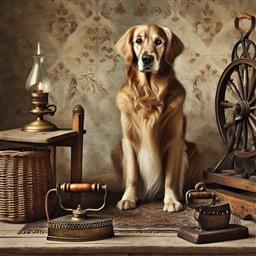
Welcome to this unique and historical compilation of canine monikers. We invite you to journey back to the 1830s, a decade filled with charm, elegance, and charisma. It was a time when names had deep-rooted meanings and were often chosen to reflect an individual's personality, status, or profession. Animals, particularly dogs, were no exception to this tradition.
Dogs in the 1830s were seen as loyal companions, protectors, and members of the family. Therefore, their names were chosen with great care and consideration. This page presents an array of such names, taking you back to a time when naming practices were as much about character and significance as they were about affection.
We hope this collection provides not only a taste of history but also inspiration for those seeking a name for their four-legged friends that carries a touch of historical charm. So, immerse yourself in the era of the 1830s and explore these names that have stood the test of time.
Names
| Name | Reason to Choose |
|---|---|
| Darcy | Named after Mr. Darcy, a character in 'Pride and Prejudice' |
| Darwin | Named after Charles Darwin, the father of evolution |
| Delilah | Biblical names were much loved |
| Descartes | Inspired by René Descartes, a famous philosopher |
| Dickens | Named after Charles Dickens, a famous author |
| Dorothy | The era loved feminine names for dogs |
| Duke | Inspired by the high-ranking titles used in the 1830s |
| Ebenezer | Named after Ebenezer Scrooge from 'A Christmas Carol' |
| Edison | Inspired by Thomas Edison, a brilliant inventor |
| Eliza | Inspired by Eliza Hamilton, wife of Alexander Hamilton, a key figure in early American history |
| Ellis | Inspired by Ellis Island, a key entry point for immigrants |
| Ernest | People preferred names with strong meanings |
| Euclid | Named after Euclid, a famous mathematician |
| Eustace | Greek names were a symbol of education |
| Faraday | Named after Michael Faraday, a famous scientist |
| Felicity | Names denoting cheerfulness were common |
| Felix | Felix Mendelssohn, a famous composer, was active during the 1830s |
| Fergus | Celtic names were often chosen |
| Fibonacci | Named after Fibonacci, a famous mathematician |
| Flora | A common name for women in the 19th century, it was popularized by the study of botany |
| Freya | For the Norse goddess of love and beauty, whose myths were popular during the 19th century |
| Galileo | Named after Galileo Galilei, a famous astronomer |
| Galton | Inspired by Francis Galton, a famous statistician |
| Gauss | Named after Carl Friedrich Gauss, a famous mathematician |
| Gertrude | Old English names were a popular choice |
| Gideon | Biblical names were still very popular |
| Grace | A popular name for women in the 19th century, inspired by the concept of divine grace |
| Guinevere | Named after the queen in Arthurian legend, which was popular during the 19th century |
| Gulliver | Inspired by the popular book 'Gulliver's Travels' |
| Hades | Named after the Greek god of the underworld, a popular figure in 19th-century literature |
Groups
1830s Geographic Landmarks
This category is inspired by geographic landmarks and places discovered or of significance during the 1830s.
| Name | Description |
|---|---|
| Alamo | Marking the Battle of the Alamo, a significant event in the 1830s |
| Andes | After the Andes Mountains, a subject of exploration and scientific study during this period |
| Atlantic | In honor of the Atlantic Ocean, a major route for global trade and travel |
| Austin | In honor of the city of Austin, Texas which was founded in the 1830s |
| Cherokee | Named after the Cherokee tribe and the Trail of Tears in the 1830s |
| Colonial | Referring to the era's colonial expansions and settlements |
| Erie | Inspired by the Erie Canal, a significant waterway in 1830s America |
| Eureka | A term associated with discovery and innovation, prevalent in the 1830s |
| Everest | Named after Sir George Everest, who was the surveyor general of India in the 1830s |
| Frontier | Signifying the expansion of the American frontier during the 1830s |
| Gold | Signifying the onset of gold rushes across various regions in the 1830s |
| Hudson | For the Hudson Bay, a significant fur trade region in the 1830s |
| Louisiana | For the Louisiana Purchase, a significant land acquisition in the early 19th century |
| Mississippi | Because of the Mississippi river, a critical trade and transportation route during the 1830s |
| Niagara | Draws inspiration from the grandeur of the Niagara Falls |
| Nile | After the River Nile, exploration of its source was a topic of great interest in the 1830s |
| Oregon | For the Oregon Trail, a crucial route for westward expansion in the 1830s |
| Pioneer | For the pioneering spirit of those who ventured into uncharted territories in the 1830s |
| Prairie | A nod to the vast prairies that settlers encountered in the 1830s |
| Savannah | Reflects the city of Savannah, a significant port in the 1830s |
| Settler | In honor of the brave settlers who ventured into new and unknown lands during the 1830s |
| Sutter | After Sutter's Mill, where gold was first discovered in California |
| Territory | Representing the new territories added to the United States in the 1830s |
| Trail | Resonating with the numerous trails people took for migration during the 1830s |
| Victoria | Paying tribute to Lake Victoria, discovered during this period |
1830s Popular Culture
This category reflects the popular culture of the 1830s, including music, arts, and entertainment.
| Name | Description |
|---|---|
| Astor | John Jacob Astor was a prominent businessman of the 1830s |
| Babbage | Charles Babbage, considered the father of the computer, made significant strides in his work during this decade |
| Beethoven | The era saw the death of famous composer Ludwig van Beethoven |
| Bronte | The Bronte sisters began writing their classic novels during this period |
| Chopin | Fryderyk Chopin, a renowned Polish composer, gained prominence in the 1830s |
| Darwin | Charles Darwin embarked on his voyage on the Beagle in the 1830s |
| Delacroix | Eugene Delacroix was a famous French romantic artist in the 1830s |
| Dickens | Charles Dickens started publishing his works in the 1830s |
| Flaubert | Gustave Flaubert, a distinguished French writer, began his career in the 1830s |
| Goya | Francisco Goya, an acclaimed Spanish painter, died in the 1830s |
| Hawthorne | Nathaniel Hawthorne, a popular American novelist, published his first novel in the 1830s |
| Livingstone | David Livingstone, a noted explorer, started his African expeditions in the 1830s |
| Melville | Herman Melville, author of Moby Dick, was born in the 1830s |
| Poe | Edgar Allan Poe started gaining fame as a writer during this time |
| Pushkin | Alexander Pushkin was a Russian poet known for his literature during this period |
| Rossini | Gioachino Rossini was a prominent composer of the time |
| Stowe | Harriet Beecher Stowe, author of Uncle Tom's Cabin, began her writing career in the 1830s |
| Tennyson | Alfred Lord Tennyson's poetry was popular throughout the 1830s |
| Thoreau | Henry David Thoreau was a prominent American philosopher and essayist in the 1830s |
| Turner | Inspired by JMW Turner, a leading British artist during this period |
| Verdi | Giuseppe Verdi, a famous Italian composer, started his career in the 1830s |
| Victoria | Queen Victoria began her long reign in the late 1830s |
| Voltaire | Voltaire's works influenced many social and political movements of the 1830s |
| Webster | Named after Daniel Webster, a noted statesman and orator |
| Whitman | Walt Whitman, an influential American poet, began his career in the 1830s |
1830s Inventors and Discoveries
This category honors those who made significant inventions and discoveries in the 1830s.
| Name | Description |
|---|---|
| Avogadro | Amedeo Avogadro, who proposed Avogadro's law, is the namesake |
| Babbage | A nod to Charles Babbage, who invented the concept of a programmable computer |
| Bell | Referencing Charles Bell, who discovered the difference between sensory and motor nerves |
| Braille | After Louis Braille, who developed the Braille system of reading and writing for the blind |
| Bunsen | Robert Bunsen, inventor of the Bunsen burner, lends his name to this option |
| Carnot | Sadi Carnot, known for his work on the Carnot cycle and Carnot theorem in thermodynamics |
| Colt | Samuel Colt, inventor of the revolver, lends his name to this option |
| Daguerre | Louis Daguerre, the inventor of the daguerreotype process of photography, is the inspiration for this name |
| Darwin | In honor of Charles Darwin, who embarked on the voyage that led to his theory of evolution in the 1830s |
| Faraday | Named after Michael Faraday, who made significant contributions to the study of electromagnetism in the 1830s |
| Fox | For the discovery of the Fox Talbot process, a precursor to modern photography |
| Fresnel | For Augustin-Jean Fresnel, who greatly contributed to the understanding of wave optics |
| Gauss | Carl Friedrich Gauss, known for his work in mathematics and physics, would be a sophisticated choice |
| Herschel | John Herschel, a pioneer in photography, is the namesake |
| Jacquard | Joseph Marie Jacquard, who invented a loom that could weave complex patterns |
| Joule | From James Prescott Joule, who made key discoveries related to the first law of thermodynamics |
| Kelvin | In memory of Lord Kelvin, who contributed to the formulation of the first and second laws of thermodynamics |
| Liebig | Justus von Liebig, who made major contributions to agricultural and biological chemistry |
| Lister | Joseph Lister, a British surgeon who pioneered antiseptic surgery |
| Morse | This name hails from Samuel Morse, inventor of Morse code |
| Ohm | Inspired by Georg Ohm, known for his work in electrical resistance |
| Stephenson | For George Stephenson, who engineered the first public inter-city railway line in the world |
| Sturgeon | William Sturgeon, inventor of the electromagnet, is the inspiration |
| Volta | Honoring Alessandro Volta, who invented the electric battery |
| Wheatstone | After Charles Wheatstone, who invented the stereoscope |
Literary Characters
This category is inspired by popular characters from literature of the 1830s.
| Name | Description |
|---|---|
| Barkis | Named after Mr. Barkis from Charles Dickens' 'David Copperfield', published in 1850 |
| Bumble | A character from Charles Dickens' 'Oliver Twist', first published in 1837 |
| Chuzzlewit | Inspired by Martin Chuzzlewit, protagonist in Charles Dickens' novel of the same name, published in 1844 |
| Copperfield | Inspired by the titular character in Charles Dickens' 'David Copperfield', first published in 1850 |
| Cosette | A character from Victor Hugo's 'Les Misérables', published in 1862 |
| Dantes | Named after Edmond Dantes from Alexandre Dumas' 'The Count of Monte Cristo', published in 1844 |
| Estella | A character from Charles Dickens' 'Great Expectations', published in 1861 |
| Fagin | Inspired by a character from Charles Dickens' 'Oliver Twist', published in 1837 |
| Havisham | Named after Miss Havisham from Charles Dickens' 'Great Expectations', published in 1861 |
| Heathcliff | From the male protagonist of Emily Brontë's novel 'Wuthering Heights' published in 1847 |
| Hester | The name of the protagonist in Nathaniel Hawthorne's 'The Scarlet Letter' which was published in 1850 |
| Hosmer | Inspired by Hosmer Angel from Arthur Conan Doyle's 'A Case of Identity', published in 1891 |
| Hyde | Named after Mr. Hyde from Robert Louis Stevenson's 'Strange Case of Dr Jekyll and Mr Hyde', published in 1886 |
| Micawber | Named after Wilkins Micawber from Charles Dickens' 'David Copperfield', published in 1850 |
| Nemo | Named after Captain Nemo from Jules Verne's 'Twenty Thousand Leagues Under the Sea', published in 1870 |
| Phileas | Named after Phileas Fogg from Jules Verne's 'Around the World in Eighty Days', published in 1873 |
| Pip | Protagonist in Charles Dickens' 'Great Expectations', published in 1861 |
| Pumblechook | A character from Charles Dickens' 'Great Expectations', published in 1861 |
| Queequeg | A character from Herman Melville's 'Moby-Dick', published in 1851 |
| Rochester | Inspired by Mr. Rochester from Charlotte Bronte's 'Jane Eyre', published in 1847 |
| Scrooge | Inspired by Ebenezer Scrooge from Charles Dickens' 'A Christmas Carol', published in 1843 |
| Sydney | Inspired by Sydney Carton from Charles Dickens' 'A Tale of Two Cities', published in 1859 |
| Uriah | Inspired by Uriah Heep from Charles Dickens' 'David Copperfield', published in 1850 |
| Valjean | Named after Jean Valjean from Victor Hugo's 'Les Misérables', published in 1862 |
| Wemmick | A character from Charles Dickens' 'Great Expectations', published in 1861 |
Historical Figures
This category is inspired by notable people from the 1830s who had a significant impact on history.
| Name | Description |
|---|---|
| Audubon | John James Audubon was a notable ornithologist, naturalist, and painter |
| Babbage | Inspired by Charles Babbage, known as the 'father of the computer' |
| Beethoven | From Ludwig van Beethoven, the renowned composer and pianist |
| Bennett | After James Gordon Bennett Sr., founder of the New York Herald |
| Bolivar | Named after Simon Bolivar, a military and political leader |
| Darwin | After Charles Darwin, the father of the theory of evolution |
| Dickens | Inspired by Charles Dickens, the famous English writer and social critic |
| Emerson | Inspired by Ralph Waldo Emerson, an American essayist and lecturer |
| Faraday | After Michael Faraday, the scientist who contributed significantly to the study of electromagnetism |
| Galileo | After Galileo Galilei, who played a major role in the scientific revolution |
| Goethe | Johann Wolfgang von Goethe, German writer and statesman |
| Goya | Francisco Goya, the Spanish romantic painter, is the inspiration |
| Hawthorne | Nathaniel Hawthorne, famous American novelist, is the source |
| Hugo | Victor Hugo, the French poet, novelist, and dramatist |
| Napoleon | Named after the famous French military leader, Napoleon Bonaparte |
| Oberlin | From John Frederick Oberlin, a famous pastor and philanthropist |
| Poe | Edgar Allan Poe, American writer, editor, and literary critic |
| Pushkin | Alexander Pushkin, regarded as the father of Russian literature |
| Rembrandt | Inspired by Rembrandt, the Dutch draughtsman, painter, and printmaker |
| Thoreau | Henry David Thoreau, American essayist, and philosopher |
| Tocqueville | Taken from Alexis de Tocqueville, French diplomat and political scientist |
| Turner | J.M.W Turner, the English romantic painter, is the inspiration |
| Victoria | Inspired by Queen Victoria, who began her reign in 1837 |
| Wellington | Arthur Wellesley, 1st Duke of Wellington, is the inspiration here |
| Whitman | Named after Walt Whitman, an influential American poet |